Editorial: : "It would require a very broadly cast cost-benefit analysis that would include the value of highways not widened, potholes not filled, work and school days not missed, red air days not suffered through and heart attacks not occurring.
Also figured in would be the forgone expenses now associated with collecting fares, enforcing the rules and handling all that cash. But a free transit system has, at least in theory, so many benefits to so many people that we would be foolish in the extreme not to give it a very hard look."
Thursday, April 21, 2016
Friday, April 15, 2016
Sunday, April 10, 2016
How can we stop capitalism from destroying the biosphere?
First, drop the supply-side bias. You cannot stop them by blocking their pipelines.
Address demand. How? Offer people a better way to live. And not just a few people out in the woods.
Make buses free in your locality. This is not new, many places have done it. When there are fewer cars, people will urbanize. When people move to town, they see more benefit in having fewer children as education becomes more important than having lots of farm hands.
You can do a lot right from where you are. Help us popularize the concept of free buses and trams. You can tweet articles right from our blogs. Or become a blogger for free transit. We will give you access.
Pro-growth urbanists love the idea of free public transit even though it is very much a degrowth policy. Free transit has immediate benefits for clean air, reducing traffic, and parking problems. The idea is spreading. And as long as it stays under the corporate media radar, it will continue spread. Don't look for help from the big names. Just join your local public transit advocates or help us online.
Address demand. How? Offer people a better way to live. And not just a few people out in the woods.
Make buses free in your locality. This is not new, many places have done it. When there are fewer cars, people will urbanize. When people move to town, they see more benefit in having fewer children as education becomes more important than having lots of farm hands.
You can do a lot right from where you are. Help us popularize the concept of free buses and trams. You can tweet articles right from our blogs. Or become a blogger for free transit. We will give you access.
Pro-growth urbanists love the idea of free public transit even though it is very much a degrowth policy. Free transit has immediate benefits for clean air, reducing traffic, and parking problems. The idea is spreading. And as long as it stays under the corporate media radar, it will continue spread. Don't look for help from the big names. Just join your local public transit advocates or help us online.


Friday, April 8, 2016
US public money wasted on sprawl, nothing left for the basics
Builder Magazine : "That's mainly because America isn't investing in its aging systems of water and sewer systems, roads, bridges and transit, opines John Rennie Short for Tech Insider. The U.S. is ranked 16th globally for its infrastructure. According to the White House, Americans spend $120 billion each year in extra fuel and lost time due to public transit's closures, accidents and inefficiencies.
Short offers a few reasons for the dilapidation of America's public transit systems, mostly blaming the growth in use of the private car and urban design focusing on motorists instead of pedestrians. For example, he cites fuel prices and restricted land use that kept population growth centered around transportation in Europe."
Short offers a few reasons for the dilapidation of America's public transit systems, mostly blaming the growth in use of the private car and urban design focusing on motorists instead of pedestrians. For example, he cites fuel prices and restricted land use that kept population growth centered around transportation in Europe."
Thursday, April 7, 2016
Mexico City car ban reduces smog levels, jams public transportation on Day 1
Fox News Latino: "MEXICO CITY (AP) – Mexico City residents packed buses and subway trains and many walked or biked to work Wednesday as authorities barred millions of vehicles from the streets due to a pollution alert.
Under new regulations imposed after the capital recently experienced its worst air-quality crisis in over a decade, 40 percent of cars were ordered off the road after smog levels hit 1½ times acceptable limits Tuesday."
Under new regulations imposed after the capital recently experienced its worst air-quality crisis in over a decade, 40 percent of cars were ordered off the road after smog levels hit 1½ times acceptable limits Tuesday."
Wednesday, April 6, 2016
Lack of #publictransit investment costing US $120B per year
Builder Magazine: "That's mainly because America isn't investing in its aging systems of water and sewer systems, roads, bridges and transit, opines John Rennie Short for Tech Insider. The U.S. is ranked 16th globally for its infrastructure. According to the White House, Americans spend $120 billion each year in extra fuel and lost time due to public transit's closures, accidents and inefficiencies."
We don't need self-driving cars – we need to ditch our vehicles entirely
The Guardian: "am rich beyond Google’s wildest driverless-car dreams; I own a fleet of swift and reliable driverless cars that take me where I’m going while I read or stare out the window or watch beautifully limber kids turf dancing in the aisles for my entertainment. I have been riding these liberating transportation marvels for many decades; I have seen the future; it is all of us in these driverless cars we already own together."
Sunday, April 3, 2016
Mexico City driving restrictions costly and useless
News Every Day : "According to Lucas Davis, an energy researcher at UC Berkeley, such programs can lead to more air pollution. Such policies can be a big problem, so the authorities hope that the people can take public transport. However, those can be too slow and dangerous.
Hence, people just manage by buying two cars with different number plates. "I just think that once people become drivers in Mexico City they don't go back," Davis said.
Instead, these rules are mostly a costly inconvenience. "A rough calculation suggest these costs amount to over $300 million per year, or $130 per vehicle owner," according to Davis's research."
Hence, people just manage by buying two cars with different number plates. "I just think that once people become drivers in Mexico City they don't go back," Davis said.
Instead, these rules are mostly a costly inconvenience. "A rough calculation suggest these costs amount to over $300 million per year, or $130 per vehicle owner," according to Davis's research."
Friday, April 1, 2016
"Cities and cars were never a good fit"
rawstory : "We may be at the cusp of a generational shift in attitudes to the car and mass transit. Cities and cars were never a good fit, something more people appear to be realizing."
Monday, March 28, 2016
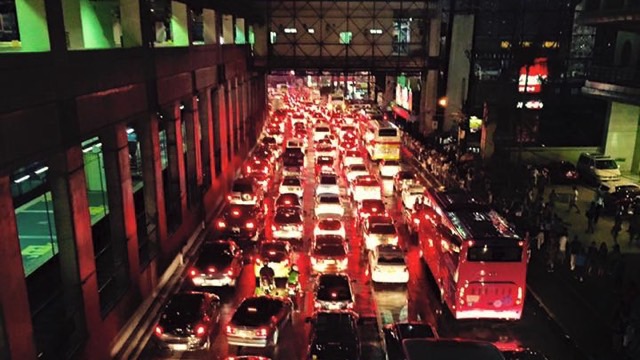
Roads in Philippines unfairly benefit the 2% who own cars
Subscribe to:
Posts (Atom)